
Let’s Talk About Last

When talking about shoes, the first two things that usual come up are styling and materials. A double monkstrap in brown scotch grain leather, or a Norwegian split toe in snuff suede for example. But let’s not forget what might be the most important aspect of a shoe: the last.
Properly speaking, the last is the form on which a shoe is made. If we’re talking bespoke, it’s a hand-carved wooden model of the customer’s feet, but for most ready-made shoes it’s some sort of poly/plastic lump that represents the shape of the shoe in a given size. Manufacturers typically have a handful of different profiles on offer, and that’s what I mean here by “last.”
The image above is from the always-on-point Ethan Desu, and represents four of Carmina’s options. It’s not hard to see how distinct each is, even ignoring all the other differences between the shoes. This image illuminates even more details.

The Inca last, on the far left, has an almond shaped toe, higher quarters in the back, and slim, but not overly dramatic waist. The Alcudia last, up front, on the other hand, lower back quarters, a sweeping waist, and a dramatically shaped toe that narrowly avoids “pointy” territory.
The two in the middle, the Simpson and Robert from left to right, are two variations on a theme. Both have a “chiseled toe” which indicates the downward curve of the toe puff to the last at the tip of the shoe – you get that distinctive curve that then drops down onto the last, instead of a more rounded, gentle shape. The Simpson is closer to the traditional, Cleverly-style chisel, with it’s slightly squared-off shape and sharp drop. The Robert on the other-hand is reminiscent of the legendary “Peal Toe,” which is softer, more rounded chisel.
Obviously this isn’t unique to Carmina. Mr. Desu has just done an excellent job illustrating the point. Another good example is this collection of Edward Green Dover’s from a post on Styleforum. All the same style, five different lasts.
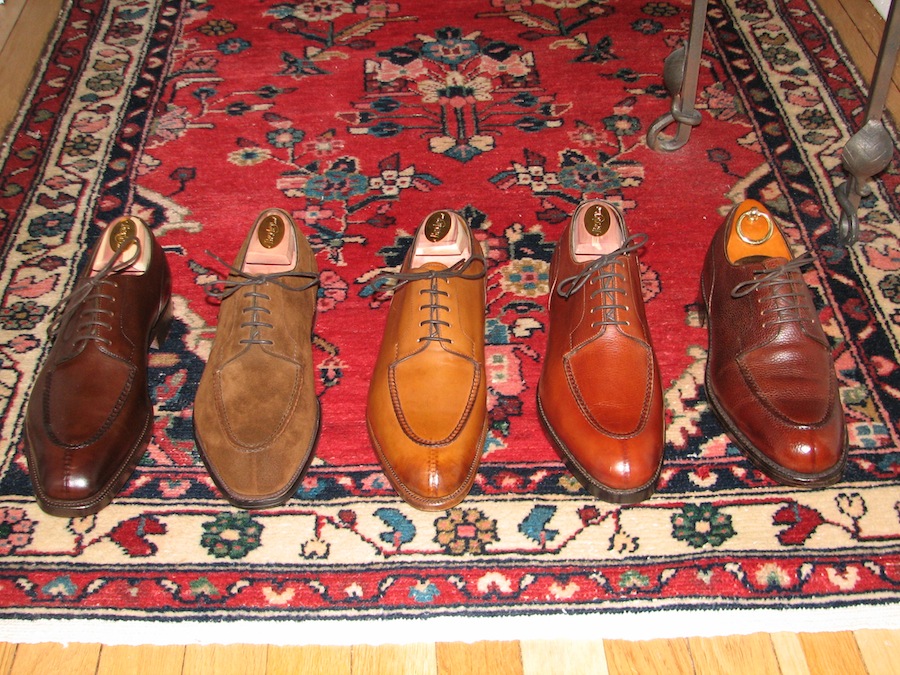
From left to right, we have a hard-chisel (888), softer chisel (606), almond toe (82), modern round (202), and traditional round (55). Unlike in Mr. Desu’s photos we don’t get a good sense of the other details, but you can see the 888 has a very aggressive waist that I doubt you’d see on the 55.
The thing this picture really gets across is the way a single style can be interpreted so many different ways. The shoes on either end are more different than similar. You’d never confuse one for the other, even though the leathers are similar shades and the styling exactly the same. Personally I think the 82 and 202 lasts work best here, elegantly carrying the detail-heavy Dover styling and keeping both the apron and toe seam in pleasing proportion.
So when you think about your next footwear purchase, don’t just think in terms of suedes and brouging. Some men can carry different shapes well, and in that case try for some variety like you would in the rest of your wardrobe. For others, some shapes will balance better, and in that case go for what suits you. Either way, last matters.


2 Comments
Kevin
November 6, 2011Does it make sense to have your own last and use it with different custom shoe providers?
If so, where in USA can a last be crafted?
If you have last and can ship to Italy or HK or other , assume a customized shoes can crafted.
THXS
Kevin
Stephen
November 6, 2011There are places to get lasts made, but with that said, I can’t recommend it. The last isn’t just the shape of your foot, but as I said it also determines the shape of the shoe. If you go with one last, you get one shape shoe. More importantly, you miss out on any observations about your feet that you’ll get at each stage with a maker. A good shoemaker is just as much podiatrist as leather-worker.
Springline (http://www.springline.net/) makes lasts in the UK, and I don’t know of any American makers.
As for each maker’s policy regarding ready-done lasts, I can’t even venture a guess. It would be particular to each, but I’d be willing to bet that any bespoke maker would heavily discourage it at best.