
A Man of Style / A Man of Fashion
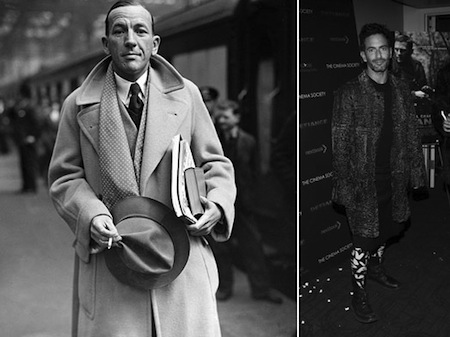
“In the classical European humanistic tradition, fashion was always thought to be antithetical to good taste. A person blindly following the whims of fashion was without style, whereas a man of style – or a gentleman – used his own power of judgment… fashion in a societal formation always combining two opposite forces. It is a socially acceptable and safe way to distinguish oneself from others and, at the same time, it satisfies the individual’s need for a social adaptation and imitation…in modern society, both style and fashion are functional equivalents to ‘good taste.’”
-Jukka Gronow, Department of Sociology, University of Helsinki (1993)
I stumbled upon this quote in an otherwise dense, but intelligent, article on Kantian and Simmelian notions of fashion as a reactionary socializing force, but thought this quote was perfect to share and discuss here.
Many classic style writers, myself included, often like to note the separation between what is classic style and what is fashion, with the later term usually being washed aside as some sort of trite and fleeting version of the former. The assertion here that they both essentially represent a notion of good taste shocked me at first, but the more I thought about it and looked at what Gronow was saying, the more it seemed to make sense in a certain way.
While I, and presumably most people reading this, find the idea that “skirts and slashed leggings are really ‘in’ for men this season” to be utter hogwash, it is amongst a certain set a call to wallets and closets. This drive towards adaptation and imitation is the primary drive here, with individual decision making and ‘style’ taking the back seat, whereas what is discussed here usually orders these drives the reverse way – in modern society, wearing a correctly fitted suit and tie outside of an office of Michelin 3 Star restaurant is usually asking to stand out, not fit in.
But then again, the so-called “fashion-set” is a select group and may stand out through a sense of collective individuality rather than truly individual individuality, however ridiculous that clause may sound. And we, again I am generalizing here, seek to find our collective identity in the company of like-minded, well-turned out rebels, and a projected return to an imaginary glory-days filled with properly rolled lapels and well-waisted boots.
So rather than continue to ramble on, I’ll just ask: What do you think of the above quotation? What do you think of the roles played by fashion and style in our society, past and present? While I would love to think I have all the answers, I don’t, so lets discuss.


3 Comments
Anonymous
August 4, 2010I'll present the opinion that fashion is supposed to be new and experimental. Take new materials and shapes and create something that fits an individuals view of the current world. Some of it works, some of it does not, but it's primary purpose should be experimentation. Style is the result of fashion over time. Take an aspect of fashion that works, refine it, learn how to construct it better, and it will eventually become part of the generally accepted standard of dress. Lots of current standards were considered experimental when they were originally released: button down collars, the evolution of the reefer to the current blazer, the Goodyear welt for shoes.
Along those lines, what is considered style in the 21st century style should be different from what was considered style in the early to mid 20th century. The environment in which much clothing is worn is different due to air conditioning and the automobile. Science has created and greatly improved synthetic fibers. The men's jacket has evolved to match: shorter cut and of lighter weight fabrics. Even if the body is wool the lining will invariably be polyester. It's just the current evolution of the form.
Anonymous
August 4, 2010And apologies for the poor punctuation – too early here on the west coast of the US. individual's and its.
Art
January 23, 2011Recently I have talked to a tailor, age 76 and still active. He says the gap between fashion and style only became that obvious in the sixties, when industry took over. "Suddenly it was possible to buy machine made suits", he said "that had not been an option before" Today he is one out of two tailor's left in a city with more than 1 million inhabitants. But he does not want to judge the development. "Suddenly you had a bunch of possibilities as a customer regarding clotnes, which you had not had before."
I also spoke to a cobbler, who again stated that times changed somewhere in the sixties, when the shoe industry launched a new collection almost every season. "That was the end of the handmade shoe", he said. If a collection only lasts 1, 2 seasons, then quality is not as important as it used to be."We could not follow that rhythm. Our shoes had to last for years, so they had to have kind of a conservative look." I guess a little group of consumers has become aware that this new alternative from the sixties – changeing your garderobe constantly – has become the only one. Then classic style and craftsmanship become interesting for some of us again.